
Test a decision before you commit to it.
Compare alternatives on the same frozen snapshot of your own data. Every input says how well it is known, and a missing value stays missing.
From a question to measured work.
Every option starts from the same frozen snapshot of your own data, so the comparison is fair.
- 01
Compare alternatives
Put two to four options side by side.
- 02
Evidence and gaps
Each input is labelled observed, verified, external evidence, assumption, inferred or unknown. Unknowns stay visible.
- 03
Calculate and stress-test
A range for each option, the inputs that would flip the decision, and stress tests such as a drop in revenue.
- 04
Board review
The Executive Board challenges the computed figures.
- 05
Your approval
You approve one option. The approval is tied to the version you reviewed.
- 06
Work and measurement
It becomes an objective, a mission and tasks. A daily check compares what happened with what was expected.
The snapshot holds what ErezAgent measures in your workspace: revenue, pipeline, customers, AI spend, capital headroom and the metrics of a linked objective, for one venture or the whole workspace. A measurement with no data shows as unknown, never as zero.
The limits, stated up front
AI can propose the structure of a model. It does not supply the numbers: values come from your data, from you with a stated reason, or from cited research. A calculated range is a conditional estimate from the inputs you gave. It is not a forecast, a guarantee or a probability.
Every input says how well it is known.
Six evidence labels sit beside every number, in the model and in the Board’s briefing.
- Observed
- Measured from your own data at a recorded time.
- Verified
- Observed, and confirmed by a stronger record, such as a payment the processor confirmed.
- External evidence
- Backed by a completed research session that cites where the number comes from.
- Assumption
- Typed by a person with a stated reason, and kept as an assumption you can check later.
- Inferred
- Computed from other inputs, or a data source a model suggested that you have not confirmed yet.
- Unknown
- No value. It stays visible, and anything computed from it says it cannot be estimated and names what is missing.
- The labels are assigned by the software, never by an AI model. They show where a figure came from, not how likely it is to be right.
- A missing value is never replaced by a guess. Each option also shows how much of its result rests on your data.
What a decision looks like.
The inputs in a decision are not all known equally well. The model says so for each one, and it keeps the gap in view instead of closing it.
Illustrative example. Not a customer result.
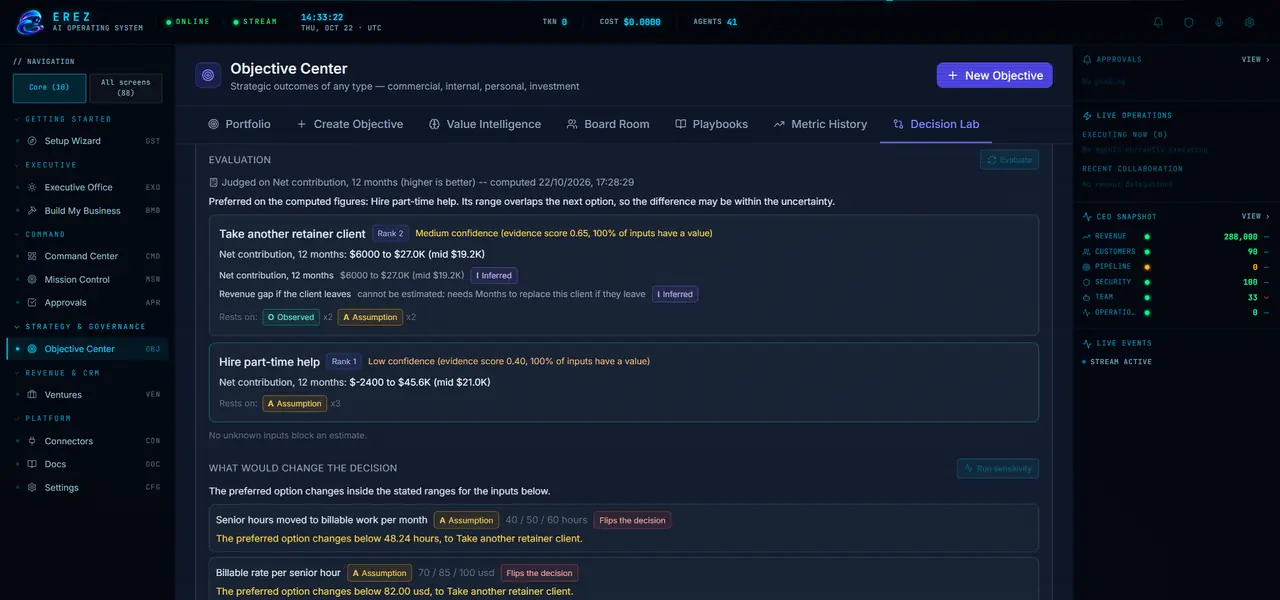
A small agency: one more retainer client, or part-time help?
A small agency compares taking on another retainer client with hiring part-time help.
- Observed
- Current revenue and customer count come from the agency’s own data.
- Assumption
- The hours each client needs, the team’s capacity and the cost of the hire are assumptions, each with a stated reason.
- Unknown
- What happens if a client leaves is unknown, so it is shown as unknown and not guessed.
The result is a range for each option, and a list of which inputs would change the answer.
Two views you will use.
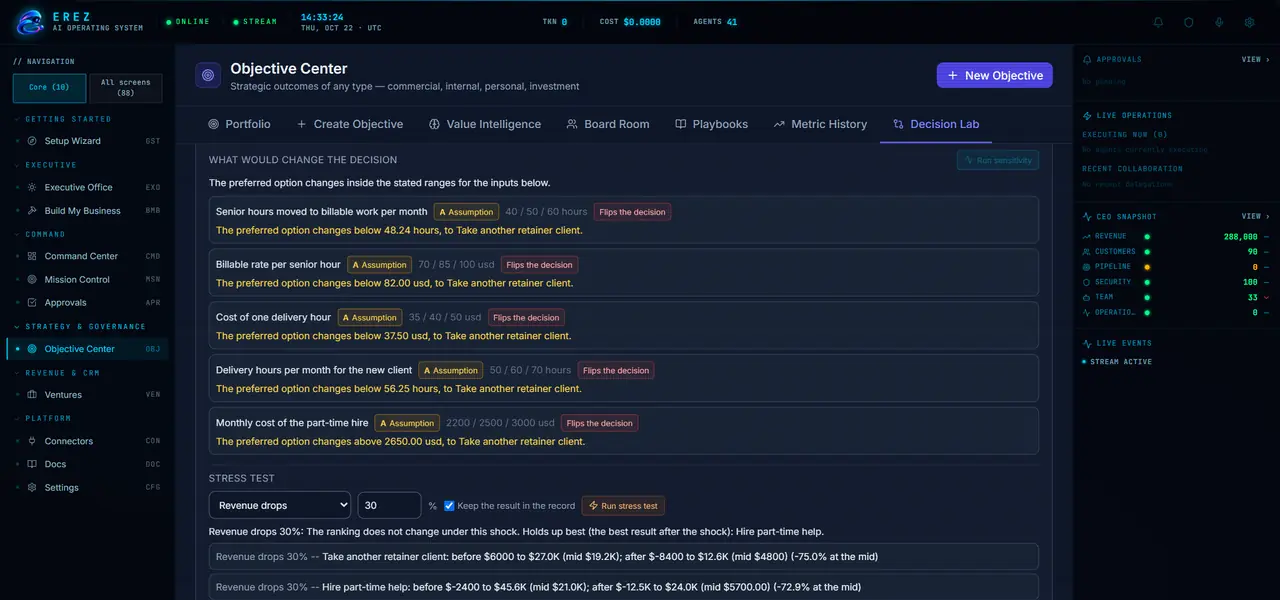
Figure 1.0 above is the evaluation view. Both views are calculated from the inputs in the decision, and neither writes to your business data.
The evaluation view
For each option, a range rather than a single number, how much of that range rests on your data, and what cannot be estimated yet. Options are ranked on the main result of the decision.
The sensitivity and stress view
Which inputs would change the preferred option, and the value at which they would. Then a shock applied to the model: a drop in revenue, a cost increase, a demand spike, churn, a loss of capacity or the loss of your largest customer.
What it will and will not do.
It supports a decision from the inputs you give it. It does not decide for you.
- Calculate a range for each option from the inputs you give it, the same way every time.
- Show where every input came from and how well it is known.
- Say “cannot be estimated” and name what is missing, instead of filling a gap.
- Show which inputs would change the preferred option, and at what value.
- Test without touching your business data: what-if values are held in memory and never saved.
- Let an AI model supply a number. It can propose the structure of a model, and only when you have allowed AI analysis; every value it suggests stays empty.
- Choose for you. The Executive Board recommends and you approve.
- Replace a missing value with a guess, or turn a typed value into observed data.
- Say how likely an outcome is, or how close a result will be to what happens.
- Sample or learn a range. A range is the low and the high value that a person or a measurement stated.
- Optimise a portfolio of ventures for you.
Values come from three places only: a measurement of your own data, a person who typed the value and gave a reason, or a completed research session that cites its source. An AI model may suggest which inputs a model needs, with their units and formulas and which measurement could supply each. Software does every calculation.
Your approval at both ends.
Choosing an option and turning it into work are separate decisions, and both are yours.
The commit is yours alone
Only the owner can approve the commit. The approval is tied to the exact version of the decision it was requested for, and a change afterwards makes it stale. If an option’s main result cannot be estimated, you have to acknowledge that explicitly first.
Turning it into work needs a second approval
Converting the chosen option into an objective, a mission and tasks is a second owner approval. The approval lists the mission’s budget, each task and its owner, and each expected value with its date. Every step is recorded, and it can be rolled back through another approval. A step whose object has changed since is reported and left alone, never overwritten.
Observers read, nothing more
Owners and operators build and edit decisions. Observers can read everything and change nothing. Venture staff and customer portal accounts cannot reach Decision Lab.
Chat and voice never commit
Asking about a decision, or what happens if revenue drops, changes nothing. Starting a decision creates a draft only. Committing and converting stay approval cards.
Approvals follow the same rules as everywhere else in ErezAgent, and every step is recorded in the audit log. How approvals work
Ask it in chat or by voice.
The same questions work typed or spoken in Executive Office.
“What is the status of my decision?”
Where the decision stands, the preferred option, how well its inputs are known, what is unknown and which inputs are most likely to change the answer.
“What if revenue drops 30%?”
A stress test on the current decision, computed in memory for the answer. Nothing is stored.
“Start a decision about …”
A draft decision from your question, for an owner or operator. It is a draft only; you build it from there.
Chat needs an AI provider; voice needs speech-to-text and text-to-speech providers. Ask from Executive Office, or use the Decision Lab tab in Objective Center.
Questions.
Decision Lab questions
01Does it tell me what will happen?
No. It calculates what each option leads to if your inputs are right, and shows which inputs would change the answer. It supports a decision and makes no claim about how close a result will be to what actually happens.
02Where do the numbers come from?
From a measurement of your own data, from a person who typed a value and gave a reason, or from a completed research session that cites its source. An AI model never supplies a value.
03What if I do not know a value?
It stays unknown. Anything computed from it says it cannot be estimated and names the missing input, so you can decide whether to find the value, state an assumption with a reason, or decide without it.
04Does testing a decision change my business data?
No. A decision reads your workspace and writes only to its own records. What-if values are held in memory and never reach your objectives or missions. Those are created only when you approve a conversion.
05Who can approve a decision?
The owner. Committing an option and turning it into work are each an owner approval tied to the version reviewed. Operators can build and edit, and observers can only read.
06Does it use an AI model?
The calculations do not. A model can propose the structure of a decision, only when AI analysis is allowed, and the Executive Board reasons over the computed figures when it reviews them.
07How do I see it on my own data?
Book a demo built around a goal or a process of yours, or apply for a guided pilot on your own infrastructure.
Decide with the gaps in view.
Book a demo built around a goal or a process of yours, or apply for a guided pilot on your own infrastructure.
Paid evaluation and guided deployment: talk to us. See the plans.