
Starter
$99 / month
or $990 per year
- 1 venture
- 5 active projects
- 3 users
Platform
Skills, connectors, chat, scheduled jobs and MCP all converge on the same executor, which checks permission, risk, autonomy tier and spending before anything happens. Open an area for the two-sentence version; the technical guide has the rest.
18 areas
Company Foundation holds the company-wide identity, principles and active company priority. Each venture has its own Venture Foundation with its mission, target market, business model and operating context.
Both are supplied to strategic reasoning, so the Executive Board deliberates with your actual context rather than a blank prompt.
Objective Center tracks metrics, targets, assumptions, progress and evidence around each desired outcome, and every objective states the measurable value it should create.
Approved direction becomes missions that combine AI reasoning, deterministic workflow steps, human approvals and background jobs, planned against the capabilities that are actually available.
Executive roles contribute independently on an objective using company, venture and operational context, and a challenge round surfaces where they disagree.
The final synthesis can include abstentions or requests for missing evidence instead of manufacturing certainty, and its recommendation can become a measurable objective.
Each agent’s identity, tools, budget and permissions are controlled separately from the language model that powers a given turn, and each workspace can set its own enablement, budget, default model and agent policies.
Agents delegate with lineage and depth limits, and people and agents can own the same tasks, with governed reassignment between them.
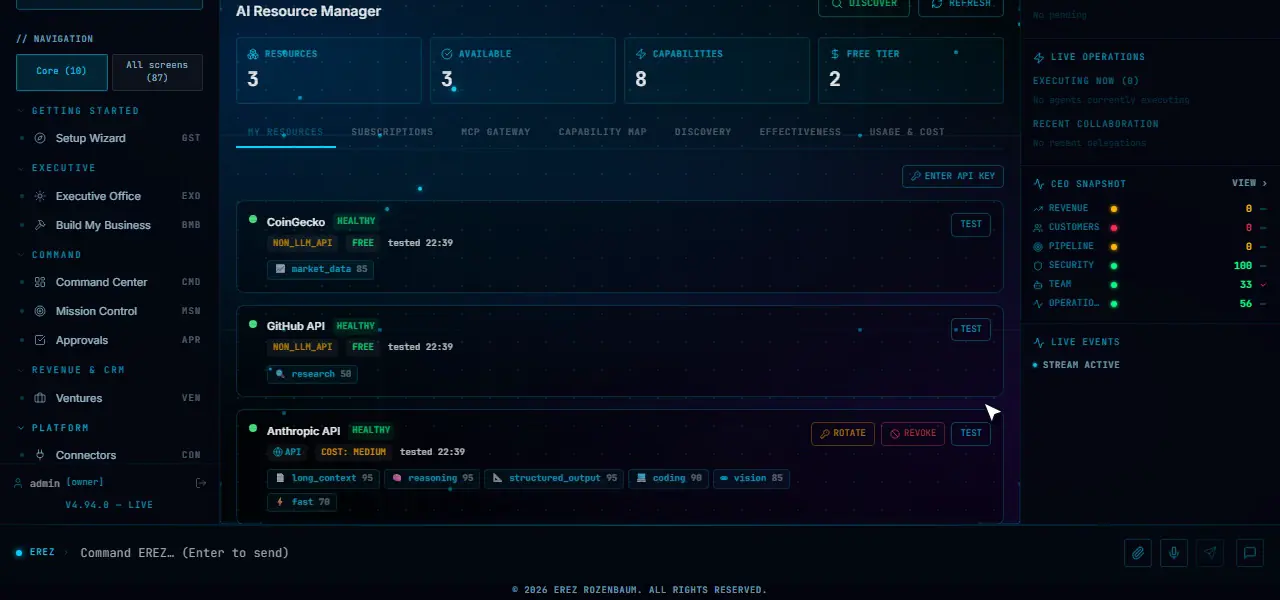
Every model call goes through one gateway that handles context, routing, caching, cost attribution and fallback. Anthropic, OpenAI, Google, xAI, DeepSeek, Mistral and Ollama can be configured at the same time.
Provider keys can be stored per tenant and rotated in the application, and Ollama gives a local-model path for work that should not use an external inference API.
Business Twin reads your documents or a plain description and proposes processes, roles, record types, rules and workflows, each marked Verified, Inferred, Assumption or Missing.
You approve a version-pinned change set; it is applied step by step with read-back, can resume after an interruption, and can be rolled back through another approved change.
The CRM workspace brings contacts, deals, projects, subscriptions, support cases, documents, appointments and activity into one view, with health and risk signals that show what needs attention now.
Document collection, support with verified resolutions, customer success and appointment scheduling run as structured systems, and follow-up messages stay human-approved.
Projects carry status, health, requirement completion and deployment state, and engineering work moves through build, test, fix, security and verification loops.
The workflow engine supports versioning, validation and restore, and orchestrations reverse completed steps in order when a later step fails, surfacing any compensation that could not complete.
Record types define fields, stages, role permissions, field visibility, document requirements and customer-facing components for processes that do not fit a conventional CRM.
Rules react to record changes or to time and can create tasks, send governed messages, add document requirements, invoke skills or request signatures.
GTM motions, offers, segments and experiments are linked to real pipeline and deal data, and deterministic detectors flag channel and offer mismatches, segment shifts and expansion candidates.
Prospect research, outreach drafts, pipeline, deals and renewals are supported, and consequential actions still pass through the normal approval gates.
Customer requirements stay traceable to their source and are classified as existing functionality, configuration, template, extension or custom software in a Solution Blueprint.
Build, test, security and deployment attach evidence to individual requirements, so formal acceptance rests on what was actually delivered.
Every governed action carries a risk level and an autonomy tier from T0 to T3; a policy can make an action stricter but cannot lower the mandatory approval floor.
Per-action daily spending ceilings are checked at the same gate, and exceeding one forces the action into approval instead of allowing silent overspend.
Model calls are measured for tokens and estimated cost and attributed to agents, models and missions; provider views label estimates separately from real provider data.
Outcomes, institutional lessons and executive calibration feed later deliberations, so the system learns from what actually happened, not only from what agents wrote.
ErezAgent ships 39 managed connectors, a REST Connector Builder and a 42-provider catalog of declarative API actions; connecting a system does not authorise every action on it.
Outbound MCP calls run through the connector layer, and inbound MCP credentials are bound to an agent, so an external client never gets more authority than that agent has.
Tenant data is isolated with PostgreSQL row-level security, roles separate owner, operator and observer, and provider keys and connector credentials are encrypted at rest.
CI and security assurance scan source, dependencies, secrets and containers; a critical vulnerability or a secret leak can block publish or deploy.
ErezAgent runs as a multi-container application (React frontend, FastAPI, PostgreSQL 16 with pgvector, Redis 7 and background workers) on infrastructure you control.
A guided web installer covers Windows, macOS and Linux, and upgrades take a backup first, verify the result and roll back when a core check fails.
One installation can run several ventures, each with its own foundation, Business Twin, records, staff roles and customer portal, selected with the venture switcher.
A shared installation can serve several tenants, each isolated at the database row level, or each client can get a separate installation.
Entitlements resolve through one path: platform-owner instance, verified licence, subscription, trial or none. Licences carry feature areas, limits and optional add-ons such as white label, multi-tenancy, local LLM and API access.
An append-only usage ledger feeds statements and invoice drafts, billed by metering or through Stripe, PayPal or Rapyd, and providers can manage downstream licences, renewals and payments.
Current scale
The product ships 260+ named skills, 39 managed connectors and a 42-provider catalog of declarative API actions. What matters is that each of them runs through the same permission checks, approval policy and audit history.
Plans
A self-hosted licence, priced by the size of what you run: ventures, active projects, users and client workspaces.
$99 / month
or $990 per year
$249 / month
or $2,490 per year
$599 / month
or $5,990 per year
$999 / month
or $9,990 per year
$1,999 / month
or $19,990 per year
Custom
Talk to us
Prices in USD for a self-hosted licence. Annual billing costs 10 months. Paid evaluation and guided deployment: talk to us.
Next step
See it run on a goal of yours, apply for early access, or talk to us about delivering it to your own clients.
Paid evaluation and guided deployment: talk to us. See the plans.